Switch-WECC
Planning low-cost, low-carbon power system investments using the Switch optimization model
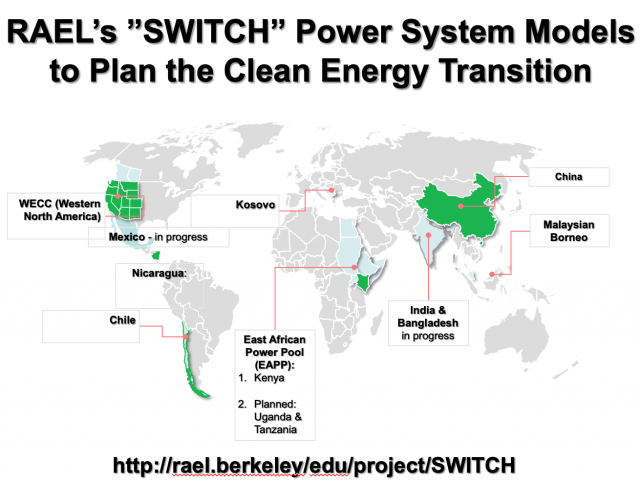
With Switch (a loose acronym for Solar, Wind, Hydro and Conventional generators and Transmission), we can explore generation, transmission, and storage options for the future electricity grid. The model identifies cost-effective investment decisions for meeting future electricity demand, taking into account the existing grid as well as projections of future technological developments, renewable energy potential, fuel costs, and public policy.
A description of the data and model formulation for the WECC version of SWITCH follows. The most recent documentation can be found here. Documentation for the 2012 Energy Policy paper, which uses a version of the model from early 2011, can be found here .
Switch was created by Dr. Matthias Fripp and applied to California for his doctoral dissertation at the Energy and Resources Group. The model uses time-synchronized load and renewable generation data to evaluate future capacity investments while ensuring that load is met reliably and policy goals are reached at minimum cost. The optimization is formulated as a deterministic mixed integer program, which is solved by standard commercial software.
RAEL has adapted the model to the Western Electricity Coordinating Council (WECC).

North American Electric Reliability Corporation Subregions
The current team working on Switch-WECC at RAEL includes:
Josiah Johnston (siah at berkeley dot edu)
Ana Mileva (amileva at berkeley dot edu)
Jimmy Nelson (jimmynelson at berkeley dot edu)
RAEL has added features to the model, including:
- Expanding the suite of installable technologies, notably carbon capture and sequestration (CCS) and storage
- Enforcing renewable portfolio standards (RPS) and carbon cap targets
- Incorporating sub-hourly ancillary services
- Implementing a present-day dispatch phase and a post-optimization dispatch check
In our publication in the April 2012 issue of Energy Policy, we show that WECC power sector emissions can be reduced to 54% of 1990 levels by 2030 (consistent with a 450 ppm climate stabilization scenarios) using different portfolios of existing generation technologies. Under a range of resource cost scenarios explored, most coal power plants would be replaced by solar, wind, gas, and/or nuclear generation, with intermittent renewable sources providing at least 17% and as much as 29% of total power by 2030. Assuming carbon price revenues are reinvested in the power sector, the cost of power is found to increase by at most 20% relative to business-as-usual projections. Figures from this study can be found below:


| Attachment | Size |
|---|---|
| Nelson_et_al_Energy_Policy_2012.pdf | 1.99 MB |
| Switch_SOM_Apr1_final.pdf | 17.93 MB |